Numbers Need Narratives to Create Community

That’s where my job as an ELA teacher makes sense to me. If I can help one student more clearly share their story, then we’re one step closer to a more connected community.

Kristen Henderson

In our world, a dichotomy is created between the qualitative and the quantitative.  You are either a numbers person or a language person, humanities or science—one or the other and you have to make a choice.  In the policy push of schools and education to always be data driven, this can make teaching decisions seem skewed toward the numbers people of the world. Percentages of students who passed, national norms, and standard deviations can fill up a lot of teachers’ time. But what do those numbers matter if they are not connected to stories and individual people? Numbers need narratives to create community.

Two years ago, when the middle school equity team was using a tool to determine our population group to focus on for math mentoring this lesson was made apparent to me. We were swamped in numbers and percentages. It was obvious we had work to do, but percentages aren’t personal. From the percentages, we found numbers of individual students. From the numbers, we found names and once we knew names we shared stories. This is when the work becomes personal. Teachers and students both are more invested when stories are shared.  Students and teachers are working together to change the narrative and create a more connected community.

A few weeks ago, a former student and cheerleader invited me to be her honored educator at the Top of the Class dinner. While sitting there listening to each valedictorian’s achievements, it was apparent that these students didn’t feel forced into a box to choose one side of their brain. Most students had high achievements in both language and math. Many were part of both Spanish club and German club while also completing calculus in the summer so they could take Calculus BC their senior year. Some were students I had accelerated in ELA in middle school so they were finished with ELA requirements as a junior but still took extra English CCP and AP classes their senior year. All these students have data and numbers to impress, but it’s through knowing and learning one another’s story that they created a community with one another.  These students shared their stories of resilience with one another in middle school and learned not only about their strengths but also their struggles.  Through this connection they were able to foster an environment that supported their learning and their growth that isn’t possible without sharing stories.

As we are raising children, students, and adults to function in a world that seems dichotomous about all issues, it is important to teach them to find points of connection.  Those points of connection are almost always created through a shared story.  It’s how we make sense of the mess of the world we live in and in order to fully make sense of those stories we need to be readers, writers, thinkers, and speakers who can clearly communicate.  That’s where my job as an ELA teacher makes sense to me.  If I can help one student more clearly share their story, then we’re one step closer to a more connected community.

Creating a Summer Fun List

A family tradition at the Henderson House is to create a summer to do list. We started this a few years back, and it’s something the girls look forward to every year. It also gives them a tangible reference when they’re “bored.” When summer comes to end, we come back to our list to reflect on our adventures that year.

1. Add variety

We try to add a variety of options: indoor and outdoor, traditions and new experiences, learning and pure fun, quick and easy, or harder with more preparations. In the past our list included things to do at home and adventures to take, but we focused our list on stay at home items this year since the summer is so uncertain. Since I teach I always have the privilege of being home with the girls in the summer and so far my husband has had the privilege of working from home during the pandemic, so we focused our energy in finding fun things to do while staying safe at our house.

2. Everyone contributes

We begin drafting a list of ideas and everyone contributes. It usually includes things the girls want to learn how to do, things we’ve seen other families doing on social media, and things we can’t get done during the school year. This year Eleanor really wants to master whistling, something she’s been working on since before the summer. We’ve watched another family grow butterflies on their Instagram stories, and tie dying was something I loved doing as a kid but has become a trend on TikTok and other social media platforms. A friend even suggested trying to tie dye with organic materials. Once we post the list, we crowdsource for other ideas, too. After we posted our list last year, we got so many other good ideas that we essentially created a second list to complete.

Summer 2020 List

3. No disappointments deal

We always have a conversation about how we aren’t going to throw big fits or be bummed if we don’t get to something on the list or if something on the list doesn’t go our way. We make our best effort to get things done, but we can’t be mad at each other if something doesn’t get crossed off. I feel like 2020 has been a constant lesson in this, so I almost felt it could go without saying this summer. Anything that wasn’t accomplished the previous summer can always be a goal for a different time of year or for next year’s list.

4. Include family and friends

The girls love to invite family and friends to complete things on the list. We can still do this during the summer even if it’s from 6 feet away. A lot of awesome summer activities still make sense social distancing: bonfires, tie dying, etc. And some of the items on our list this year can be done through FaceTime calls too. We’re all working on memorizing a Psalm, and we can encourage family and friends to do that as well and we can share on FaceTime if we can’t get together.

Last Year’s List

Share your ideas

Share your ideas for your list! A lot of the fun is seeing what others want to accomplish during the summer. What fun will you be having?

Creating Meaningful Assignments during Corona

Like all teachers right now, I am learning how to teach remotely on the fly. While our school/district already had a lot of pieces in place to make things go smoothly: 1-to-1 iPads for the entire district, regular Google Classroom use in our building, two years of serious equity training, teaming at the middle school to help make sure kids are accounted for, and many other structural supports, it’s still difficult to know there are a multitude of struggles families are facing during this time. And for many of us, we had certain kids we checked on everyday or provided a safe space for in our rooms who we may not be able to get in touch with now.

So once we move past knowing that we can’t fix everything even if wish we could, how do we plan assignments that are relevant to our content area but also might be helpful to the well-being of our kids while they’re at home? Thankfully, being a language arts teacher makes it so easy to also care for the social and emotional needs of my students. It’s practically built in to our standards if we just choose the right things to be reading and writing.

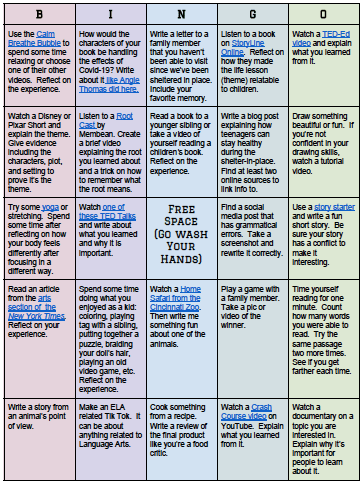
Out of all the assignments I’ve created now that we’ve been out of the physical building for almost six weeks, a choice BINGO board has been the most successful, so I thought I’d give some tips on what to consider when creating options for kids to do at home.

1. Layer Choices

As a gifted intervention specialist, choice is the cornerstone of my teaching. It increases engagement and motivation. Plus, I hate being told what to do, so I understand why many kids are turned off in the same way. By giving them choice, they are automatically more interested and more likely to complete the assignment. In the BINGO board, there is layered choice. Not only do they choose which 5 squares to complete, but some squares also give them choices. For example, one square says, “Watch a Home Safari from the Cincinnati Zoo.  Then write me something fun about one of the animals.” The more choice, the less constricted students feel, which makes them more likely to do work with less complaining.

2. Make SEL a priority

During an unprecedented time, this is the most important piece. Students are in all different situations with all different types of supports for their social and emotional needs, so it is critical for teachers to provide what support they can in this area knowing that for some students it will be supplemental to what their parents are already providing and some it will be the only consideration given to SEL. Many of the blocks on the BINGO board aimed to support students in this area. Practicing mindfulness with Calm app videos on YouTube, trying yoga, spending time doing something you enjoyed when you were younger, writing a letter to a family member you haven’t been able to see since the Stay at Home order began, playing a game with a family member, writing a blog post about how to stay healthy during Covid-19… all of these support students’ emotional and mental health along with keeping their minds and bodies active.

3. Amplify the right voices

While linking activities, it was important for me to consider whose voices I’d be amplifying during this time. It is always important to guide students to see people who look like them and who are relevant to them. Therefore I’ve linked writing resources from Jason Reynolds, creative writing ideas from Angie Thomas, StoryLine Online that has lots of actors and books to choose from, CrashCourse videos from John Green, drawing tutorials from Vashti Harrison on Instagram. Make sure you’re guiding students to relevant, accurate resources.

4. Balance reading, writing, and doing

The ELA standards boil down to reading, writing, speaking, and listening. This is the time of year that would typically fall after state testing and a time to do things that are more fun. I usually save flash fiction narrative writing for after the test since narrative isn’t on the test, but we wrote those early this year because the Dayton Metro Library was having a contest. So we’re having fun making sure that no matter what way the BINGO goes there is some combination of reading, writing, and doing that will support both their health and their content knowledge and maybe add a little fun.

While this assignment took a while to create, it was quick to grade and brought me some joy as I saw how students reflected and interacted with it. There are two versions available for free in my Teachers Pay Teachers store.

Play in the time Time of Corona

Play is a sanctuary of safety. Play is also the original school, far more effective than anything society could possibly invent…in true play the engagement is in the activity, not the outcome.

Gordon Neufeld

Play is essential to childhood and learning, but to be honest there’s not always a lot of playing at the Henderson house. We made sure the girls went to a preschool where play is a centerpiece in the day (shoutout to The Overfield School), and the girls play a lot at their grandparents’ houses. But, we don’t spend a lot of time at home. Until now.

Because of this extreme change, we’ve had to reevaluate and reflect on the way play happens in our home. Screaming, crying, and door slamming still occur…we’re just trying to lessen those things! Through trial and error and reflection, we’ve come up with some points on play to help us stay sane while we try to get our work done with kids who have been together way toooo long now:

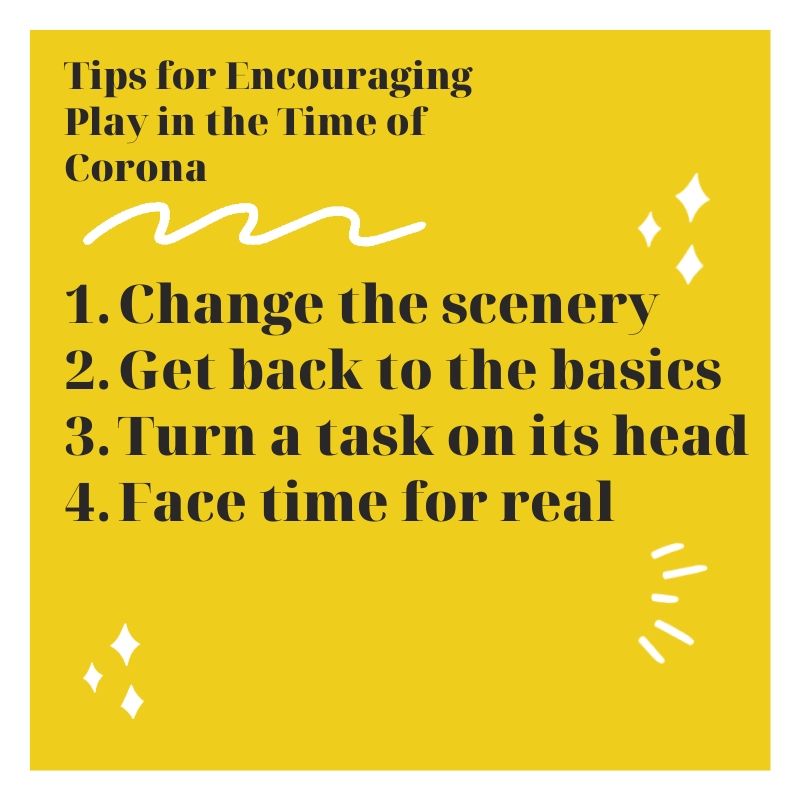
1. Change the scenery

When you’ve been stuck in the same area for a while, things get boring pretty quickly. Also, I noticed as SOON as I cleaned up an area or rearranged a space, the girls were immediately in that space wrecking what I had already done. So why not use this to my advantage?

A quick rearranging has resulted in much longer play in areas. The novelty of a “new space” lasts much longer than just yelling at them to go to the playroom or the backyard.

Some ways to do this:

  • Move the play kitchen to a different room for the day
  • Push the couches together
  • Scoot the kitchen table into the living room (this created two new spaces, a dance floor in the kitchen and a fort in the living room)
  • Move toys to the kitchen table before they wake up in the morning (Barbie was ready for a breakfast tea party)
  • Laundry baskets or car seats as “movie theater seating”

Essentially any novelty results in longer play. The brain likes it.

2. Get back to the basics

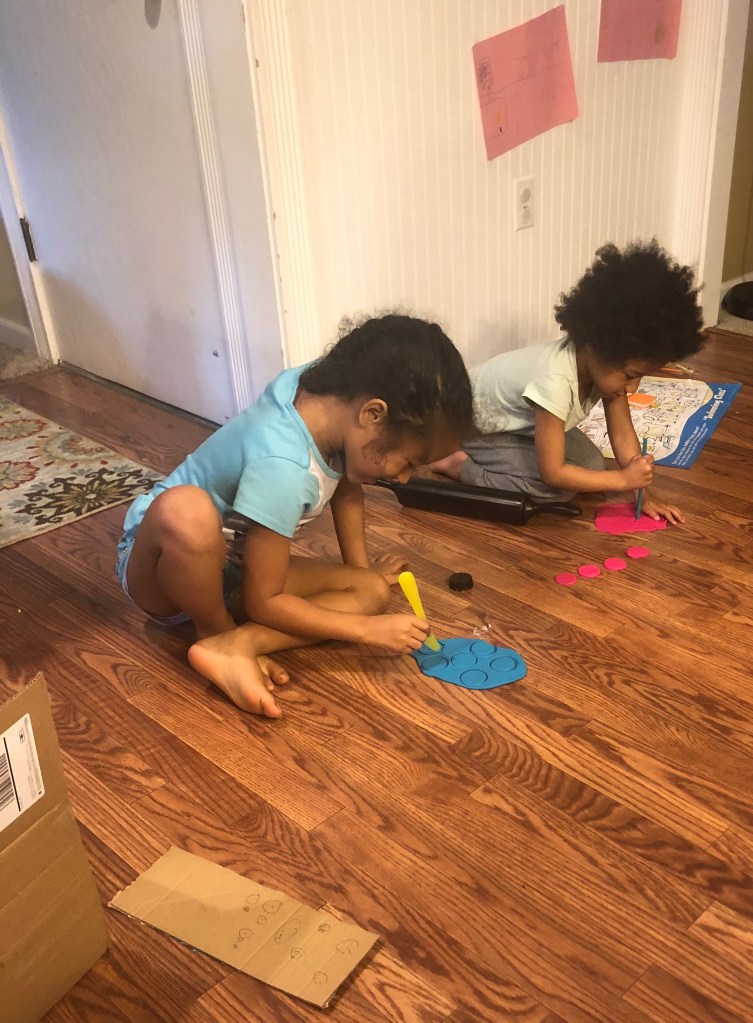
Are you having groceries or other items delivered now? Save the cardboard boxes. Don’t throw away the lids from your OJ or kombucha bottles. Leftover party supplies from a past birthday? Get out the paper cups. Break out the Play-doh or create some of your own.

Our kids have spent the most time playing with the basics. They spent almost 30 minutes rolling out Play-doh with the rolling pin and using lids of varying sizes to make “cookies” and “pepperoni pizzas.”

After watching one of the LUNCH DOODLES with Mo Willems! videos, they made puppets out of toilet paper rolls. (Speaking of, we haven’t bought an since this started…and we still haven’t run out.)

Eleanor was supposed to make a tower with paper cups and cardboard, but she ended up making a cardboard “TV” and remote.

Basic toys encourage problem solving, creativity, and motor skills that the battery powered toys just don’t deliver on.

3. Turn a task on its head

This is a note we took directly from the girls. One of the days where Dwayne and I both had to work all morning and couldn’t give a lot of attention to the girls we were given tickets that said “Dine Out Not in” Henderson Party of 2. When it was time for lunch, we came out back to a picnic blanket and sandwiches. PB&J for Eleanor and me. Turkey and cheese for Harp and Dwayne. They had even written love notes in Sharpie on the bags for each of us. This was a win-win situation. They had spent time playing to set it all up and had taken care of a task for us yes.

It took them 45 to set this up for lunch outside.

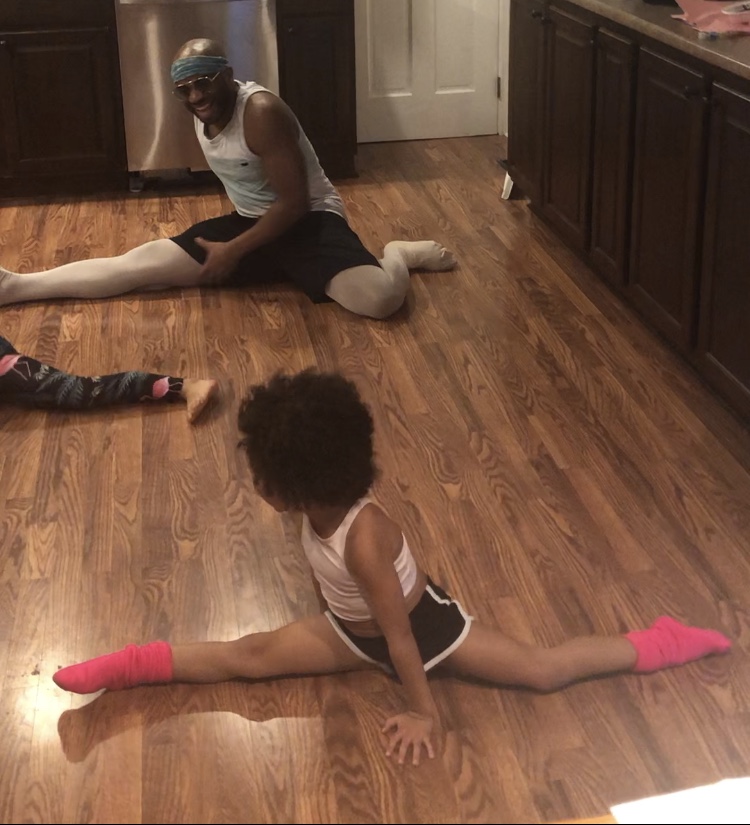
4. Face time for real

We’ve had A LOT of FaceTime calls with family members lately, but kids need face-to-face play time with the adults in the house, too. The good news for parents who are trying to get work done is that it doesn’t have to last long. Modeling fun, imaginative play, which in our house a lot of time includes Barbie dolls doing crazy things or play kitchens cooking up new foods, is beneficial for kids learning to play independently. It also helps them continue the play on their own. Wrap up the play with a hug or kiss and a “Thanks for playing with me.” This helps end on a positive note, and you can go get some work done while they’re still wrapped up in the play.

And when all this fails, give them iPad time 🙂

Letting Little Ones Text

Let’s be honest. Everyone is getting more screen time than normal, even our little ones. If we want guaranteed quiet time to work on virtual meeting calls, then a screen will be involved. Our kids are still getting plenty of play time, but play time is loud, sometimes involves screaming at one another, and always ends in one of the girls coming to us to tattle on the other. Screen time is quiet, unless the internet freezes up.

Ironically, as the youngest, Eleanor has the most unsupervised screen time because Dwayne and I still have work to do and Harper has school work to complete (or to put off completing). It’s not all bad news on the screen, though. I’ve started to be really impressed with some literacy skills she’s been developing from sneaking my phone and texting her grandparents.

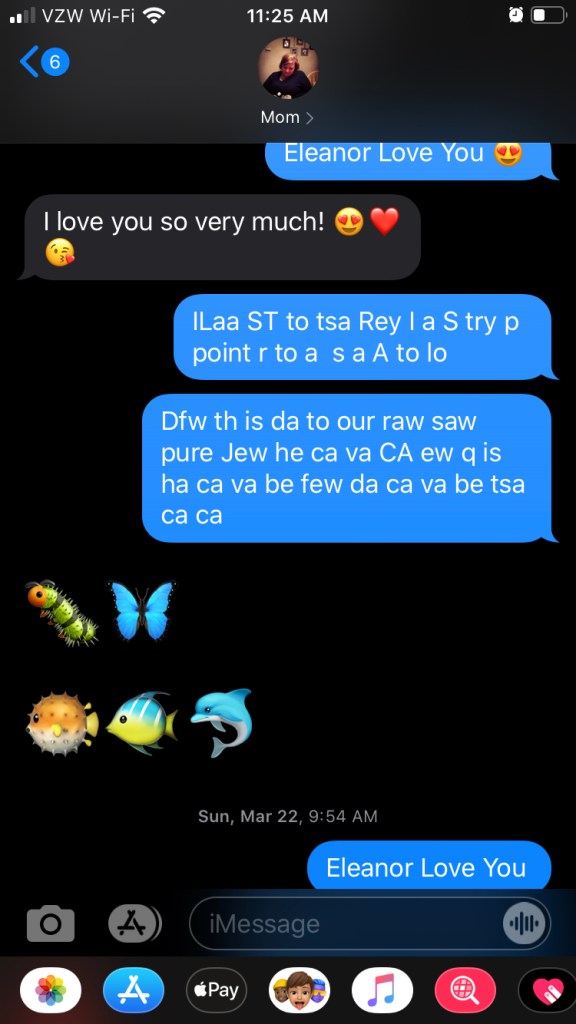
This actually started before we began sheltering in place. Eleanor snuck my phone one night and sent some text messages to one of my bosses that included lots of beer mugs and fire emojis. 😒😒 She got in big trouble, but I could tell she was interested in communicating this way, which makes sense. She sees everyone around her using texts to communicate…..so we made a deal.

Setting Boundaries

It started with her only being allowed to text my mom. My mom is one of the few people who has a picture attached to her contact, so my 4-year-old always knows who it is and has no excuses about not being able to read. She now can read a bit more, so she knows she’s only allowed to text family members. No more “accidental” messages to the wrong people.

Emergent Literacy through Emojis

There’s not a ton of research out there. But I have a feeling it’s coming. As kids continue to be read text messages (typically from ones they love), there’s an urge for them to want to communicate in the same manner. Eleanor began doing that through strings of emojis.

Since mom typically responds in bitmojis, pictures, other emojis, or gifs Eleanor is able to understand and respond independently. Her responses have become more sophisticated as time goes on.

She knows how to type her own name and she knows how to type love you. And sometimes after trying to find letters and make words has become too taxing, she just types random letters for fun.

In this message she sent today, Eleanor was able to respond by using the predictive text to choose the right words she wanted to communicate. Something she figured out on her own.

Audio Messaging

She also will frequently send audio messages through texts. To be honest, she showed me how to do this. I never knew how people sent those little recordings of themselves as messages until I watched her send them back and forth one day.

Using Siri to Send More Complex Text

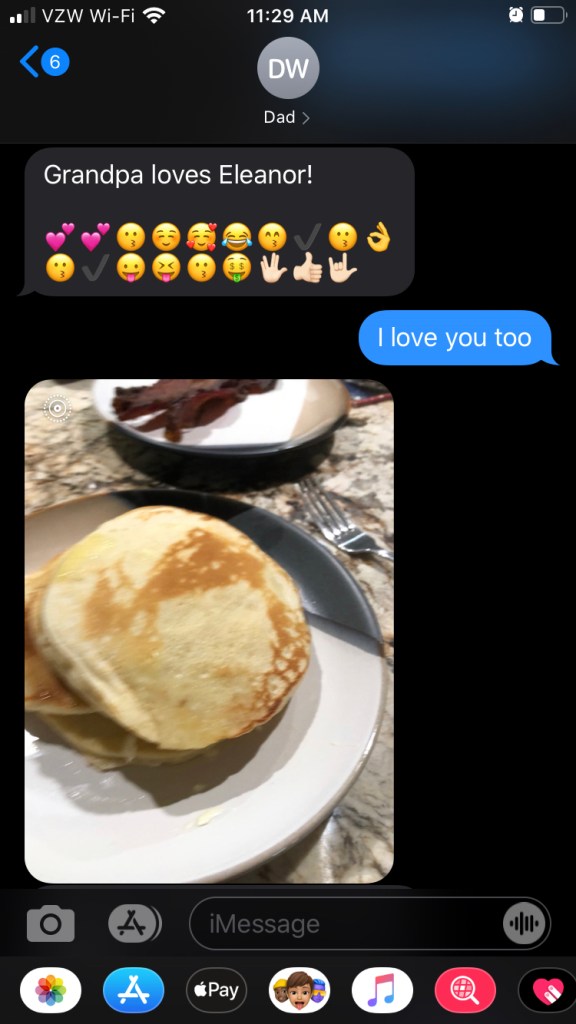
This morning I witnessed her using some problem solving skills as well. My dad had sent her a good morning text accompanied by a picture of his pancakes. Lying next to her I watched her try to figure out how to respond talking about how delicious they looked and she realized there was no way that was happening. She hit the button to turn the screen off completely and then asked Siri to send the text for her.

She told Siri to say, “Those look delicious. Can I have one?”

Close enough, right?

Guilt Free Screen Time

In all, parents need to make sure they’re not feeling guilty about the excessive screen time some of our kids are getting right now. We have to do what we can to make it work. But some early literacy skills in there are an added bonus, right?

Being Intentional With Choice in The Classroom

Most teachers know that student choice is important in the classroom. But sometimes it can be oh-so-tempting to assign a whole-class writing topic based on whatever unit we are in. Then you can easily guide them to similar resources, you can speak more easily to structure, and you can grade more quickly when they’re all the same topic. But to be honest, by the time I get to essay #126 on the same topic… I’m done. Since we started this year with independent reading instead of a whole class novel, we are starting with an informational writing piece on a topic of choice as well.

How to Be Intentional

I knew that if I just said, “Okay everybody we’re going to write an informational essay, and you’re choosing the topic.” I wouldn’t have children cheering and ready to start writing right away, so I had to be careful with my approach. Since it was the beginning of the school year, some of their daily writing in their writer’s notebook was geared toward finding topics they cared enough to write about, but they just thought it was typical getting to know you activities…what’s your dream job, what issues do you care about that it seems like the news or media doesn’t, etc. We read Say Something by Peter H. Reynolds and talked about what issues we had something to say about. We watched “The Danger of Silence” by Clint Smith and talked about what topics we wished we spoke up about more often. All of this lead to choosing a topic.

Making the Choice

When it came time to actually make the choice, students were asked to reflect on what they had already written about and do three things to make sure the topic would work for the essay:

  • Choose an issue that matters to you: We talked about how to filter topics through the lens of an “issue.” One student said, “But I just want to write about sharks.” Immediately students were talking about how to name the topic as how sharks are important in the ecosystem, why excessive fishing is bad for sharks, hunting for shark fin soup, and so on.
  • Gather words around the topic: Students generated vocabulary that accompanied their topic. This was to help come up with subtopics and search words for finding sources.
  • Find credible sources: Students were asked to find two credible sources that addressed their “issue.”

An Assortment of Topics

The list from my first period alone is enough to show that I would never be able to come up with a topic that was important enough to matter to all 126 of my students. Not a single topic was duplicated and each student chose an issue that matters to them, which in turn means the writing process is going to be smoother and they are going to be more motivated than if I had chosen something for them.

  • The Assassination of MLK Jr.
  • The Epstein Case
  • Social Media Influencers
  • Why People Should Care About Amazon Fires
  • Why Dress Codes are Unfair
  • LGBTQ Issues
  • Why Lover by Taylor Swift Should Be More Respected
  • Equal Pay in the Workplace
  • The Importance of the Battle of Gettysburg
  • Climate Change
  • Giraffes are Going Extinct
  • Italy vs. Ethiopia Before WWII
  • Morality of Zoos
  • Global Warming
  • Lack of Diversity in Modern Movies
  • Why It’s Important to Know World History
  • Cancer Prevention
  • Trash in the Oceans
  • Similarities and Differences in the Reigns of Stalin and Hitler
  • Formula One Racing
  • Delayed Gratification

Book Speed Dating

I typically start the school year with a whole class read, but after reading 180 Days by Kelly Gallagher and Penny Kittle I decided to establish our independent reading for the first few weeks and then jump into the whole class novel later. That left me wondering what I can do to get the kids not just reading but excited about reading.

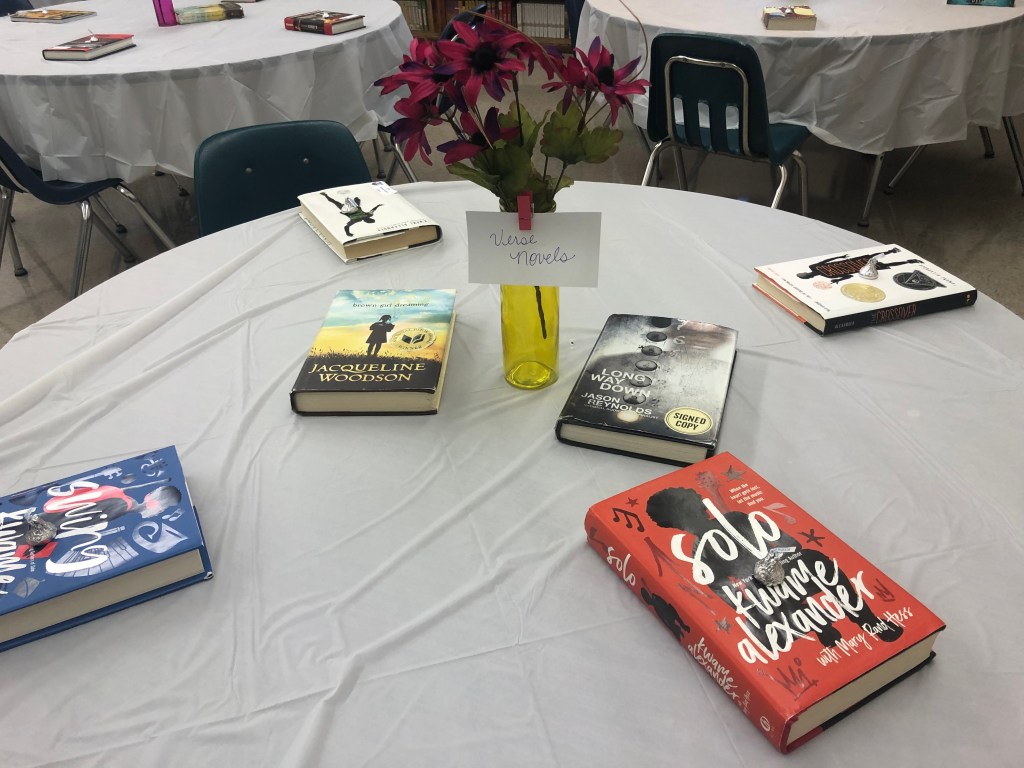
I had seen the blog posts about book tastings and book speed dating, so I decided to try it on my own. I headed to the local Dollar Tree and got some supplies to make it fancy and fun for cheap and got it set up. I got a vase and a fake flower bunch for each table along with a tablecloth. When I got to school and started setting up, I realized I could write the genre or format for each table on a note card and then paperclip it to the vase. As soon as the kids walked in the room, they were already excited for something different.

Each table was a different genre or format.

Set Up Tips

  • Group books by genre or format. I had: verse novels, graphic novels, creative nonfiction, realistic fiction, historical fiction, dystopia, and mystery/thriller.
  • Have more books at each table than chairs.
  • Make sure there is plenty of variety in titles and authors.
My slide presentation is available on Teachers Pay Teachers.

In the classroom

We ran the speed dating in three phases.

  1. First Impressions: Students had one minute to flip through all the books at the table, look at the covers, read the dust jackets, check out font size/white space, etc. I also asked students for a favorite love song and played one minute of it. (You’ll find out some interesting music preferences.) When the music stopped, they had to choose one book to take to the next phase.
  2. The “Talking” Phase: My students are always talking about who is “talking” to who. It’s a newer dating phenomenon where you’re not actually dating, but you’re trying to figure out if dating would work… so we used this as the second phase of book speed dating. You had to choose one book from the table to read for 3 minutes. You could only read that book and you had to stick with it for 3 minutes to find out if it was “the one.” The irony of the “talking” phase in book speed dating is that it’s silent during those three minutes.
  3. Match: If after the three minutes are up, they want to continue reading the book then it’s a match! Students write it on their list of books to read someday and then they find a new table to sit at. The process then starts over.

I created a presentation to go over these phases with the kids that is available on Teachers Pay Teachers.

Odds and Ends

  1. Students were not allowed to take books with them at the end of each period. They were allowed to email me or send me a message on Google Classroom to claim a book. I had a few request the same book, but I was able to find copies from other teachers or the school library for them.
  2. I gave each student a Hershey kiss at the end of the period, so everyone’s date ended in a “kiss.” That got some awkward middle school laughs.
  3. At the end of the day, I went through my emails and put a post-it with the name of the student who had claimed the book on the cover. I then stacked all the claimed books in one space and the unclaimed books in another. That allowed students who hadn’t taken the initiative to claim a book through email to have a space in the room to find a book they liked from the day before.

So far, it’s been the best start to independent reading in my classroom. There have been minimal moans and groans when it’s time to read because most students are reading something they love!

Wordless books

Books with no words are intimidating.  I remember picking one up and thinking: What do I do with this?  When I was visiting my daughter’s preschool, one of the moms was supposed to be reading the book she purchased the school in honor of her son’s birthday, but it didn’t have words so she didn’t know how to read it to the group of four-year-olds.  However, we’ve found books without words to be a gift of love and literacy to our family.  We’ve listened to our girls try out new words, add transitions to their stories, and giggle at plot twists that daddy adds.  This is how the Hendersons maximize the potential of books with no words…

  1. Set Ground Rules: Our ground rules are that each person gets a two-page spread.  One person is the story teller for those two pages.  You can’t tell someone else what they should say when it’s her turn.  You can’t complain about someone else’s part of the story.  (We slip up a lot, but we know this is the standard.)
  2. Model good storytelling: The kids listen and pay close attention to everything we say.  We try to include transition words, use suspense, add humor, and always have descriptive details.  The girls almost always model one of those techniques on their next page.
  3. Interact with the book: We ask the girls about their choices in the story.  When a character gets excited, we stop for a dance party break.  If a character is scared, we stop to show what we would look like in that situation.
  4. Switch it up: The difference (and joy) of wordless books is that the story can be different every time.  It can be a little bit different or it can be completely different.  Sometimes our girls want the characters to have the same names; sometimes they want to give them new names.  The awesome thing about it is that they own the story, so it can be whatever they want.

Our girls love Journey by Aaron Becker.  I hope to introduce them to Harold and the Purple Crayon by Crockett Johnson soon to see if they notice any similarities.  What wordless books do you enjoy?